
Barbilophozia sudetica
| Common Name | Hill Notchwort |
| Quick & Dirty ID | XXXXXX |
Image Gallery



Distinguishing Features
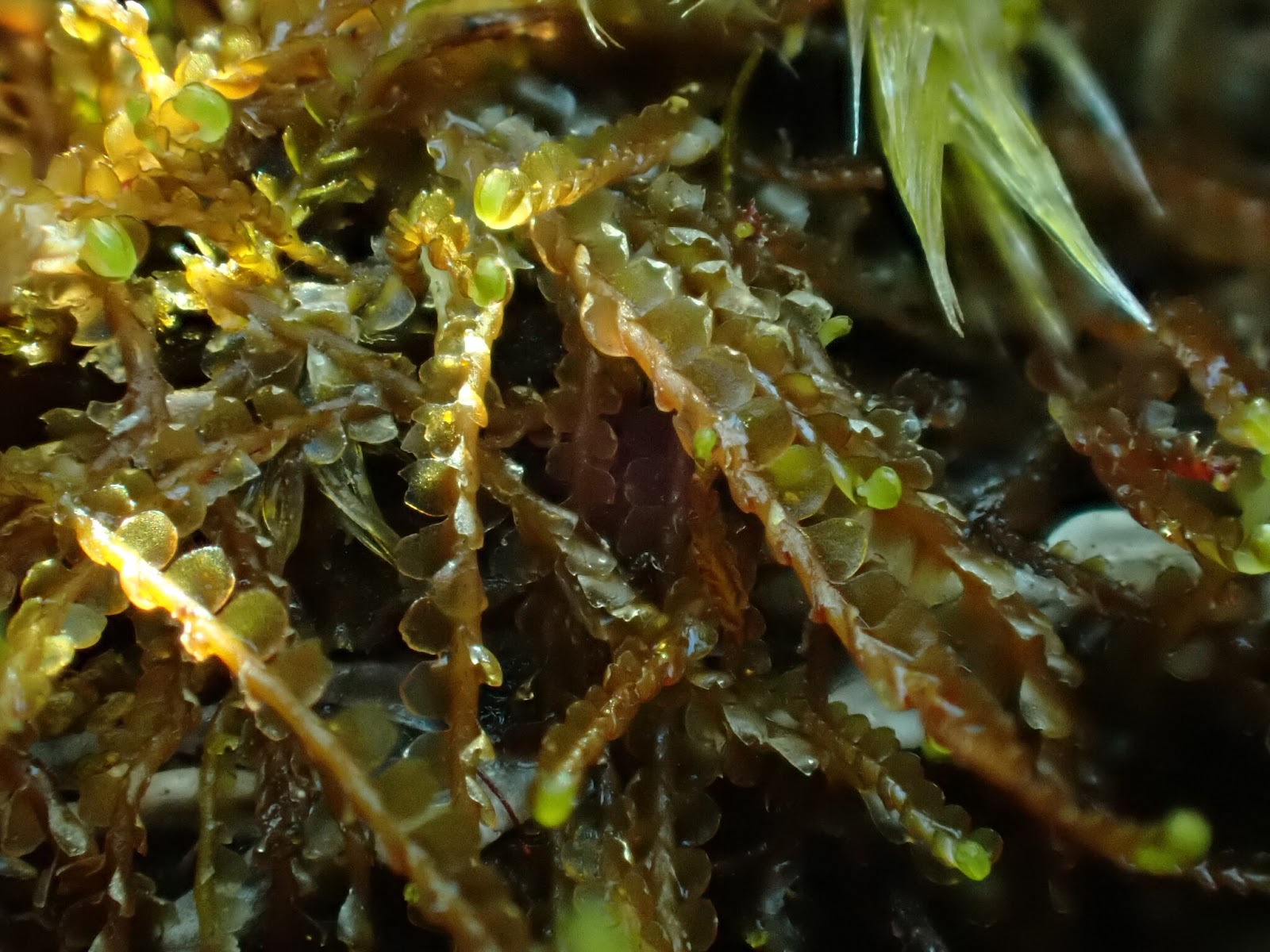
With typically 2-3 lobed lateral leaves on green shoots that are often tinged with rusty pigments at their tips, B. sudecita is an anomalous member of the genus known from montane habitats where it tends to dwell in rock crevices and ledges in squat patches of horizontal leafy shoots up to 2 cm long and 2 mm wide. Close inspection with a hand lens reveals no underleaves, which in combination with the 2-to-3 shallow lobes with dull tips makes this unique among regional species in its genus. Brownish, angular and two-celled gemmae are often present at the lobe tips.
Similar species
The obliquely to subtransversely-inserted bilobed leaves put B. sudetica in league with a number of species of Lophozia, a genus into which it has been frequently lumped. Species of Lophozia (and Lophoziopsis) lack the reddish pigmentation and those that occur in the same subalpine habitats (L. wenzelii, Lophozia ventricosa) tend to dwell on organic substrates and/or bear green gemmae. B. sudetica has brown gemmae and grows amongst rocks. Harpanthus flotovianus and species of Mesoptychia can be similair in size and leaf form but again lack the reddish pigmentation and also possess underleaves that are absent in B. sudetica. Schljakovia kunzeana has very similair pigmentation to B. sudetica and inhabits the same montane rocky substrates, but it also has prominent underleaves that are visible with a hand lens.
Habitat
Moist to wet, often shady humus, rock outcrops, boulders, cliffs, streambanks, waterfall spray zones, seepage sites, heath, and tundra in the upper montane, subalpine, and alpine zones
Associated species
XXXXXX
Distribution Map
Relevant Literature
- Godfrey, J.D. (1977). Hepaticae and Anthocerotae of southwestern British Columbia . [Doctoral dissertation, University of British Columbia]. UBC cIRcle.
- Hong, W. S. (2007). Scapania. In Flora of North America Editorial Committee (Eds.), Flora of North America North of Mexico (Vol. 3) . Oxford University Press.
- Wagner, D. H. (2013). Guide to the liverworts of Oregon: Scapania undulata . Oregon State University Herbarium.